Microsoft Solitaire Collection
- 3.9
- Rating
- 10.00M
- Installs
- Free
- Price

 Analysis by App-foxy
I opened Microsoft Solitaire Collection expecting a familiar card game and found something broader: a collection built around the simple pleasure of making one useful move, seeing the board respond, and deciding whether I could improve the next position. It remains easy to start, but it is not limited to one old-fashioned version of solitaire. The package combines classic card modes with match-three, arcade, and puzzle-style activities, so it can serve both a quiet five-minute break and a longer session when I want more variety.
That range is the main reason I would recommend it over a single-mode solitaire app. I can stay with a traditional layout when I want calm concentration, then switch to something more active when repeated card play starts to feel predictable. The experience is free to download, rated for Everyone, and developed by Microsoft Corporation. Its broad reach is reflected in an average rating of 4.0 from around 281 thousand ratings, with over 10 million installs.
How the play loop keeps pulling me into another round
Before I start another round, I like to decide what kind of attention I have available: a familiar card layout rewards patience, while switching activities can make a short break feel less repetitive. That small choice helps me use the collection intentionally instead of tapping through modes at random. It also makes it easier to notice when a stalled session is really a sign to pause rather than keep chasing one more win.
You May Also Like

 AccuWeather: Weather Radar
AccuWeather Review: A Quick, Clear Forecast for Everyday Decisions
For everyday plans, the best forecast is the one you can understand quickly. AccuWeather makes rain timing, radar, and local conditions easy to act on, with a few trade-offs.

 Hill Climb Racing
Why Hill Climb Racing Still Turns Crashes Into One More Run
A tiny car, a bumpy hill and one more upgrade: Hill Climb Racing keeps resurfacing because its simple chaos makes every near-miss feel personal.

 AliExpress - Shopping App
AliExpress Makes Global Shopping Feel Personal, but Shoppers Bear the Risk
AliExpress turns a global marketplace into a pocket-sized discovery engine. Its reach is useful, its shopping loop compelling, and its trade-offs easy to miss.

 Lords Mobile: Kingdom Wars
Lords Mobile Is a Kingdom-Building Routine, Not a Quick Match
A case-by-case verdict on the building, battles, device demands, and social commitments that make Lords Mobile rewarding for some players and exhausting for others.

 PDF Scanner app - TapScanner
TapScanner Makes Paperwork Easier to Capture, Check, and Share
TapScanner makes scanning with a phone feel less like a rescue operation and more like a dependable step in getting work done. Its capture tools are useful, though not flawless.

 Block Blast!
 Shows How Much a Puzzle Game Can Leave Out
A quiet grid game shows why puzzle players increasingly value instant clarity, repeatable skill and low-pressure play—and where the genre still needs to catch up.
More From Our News Desk
View All News


The first action is deliberately familiar
The best part of the first minute is that I do not need to learn a complicated control scheme. I tap a card or a destination, make a legal move, and immediately see whether the layout opens up. That direct relationship between action and result makes the game approachable for someone who has not played solitaire recently. There is no need to understand a large set of menus before reaching the actual cards.
In a typical round, my first useful decision is not always the most obvious card movement. I look for a move that exposes a hidden card, creates space, or keeps several future options alive. That small change in mindset makes the game feel less like randomly clearing cards and more like managing a limited set of possibilities. The interface supports that process well because the important information is visible on the board rather than buried in instructions.
This is also where the collection works well for casual use. If I am waiting for an appointment or taking a short break from work, I can begin a round without committing to a long story, a multiplayer match, or a complex objective. The game gives me a clear starting point and lets me decide how much attention I want to invest.
Players who already know solitaire will recognize the basic rhythm, but the different modes prevent the application from feeling like a single recycled table. The classic offerings are the anchor, while the additional match-three, arcade, and puzzle games provide a change of pace. I appreciate that distinction because my preferred mode depends on my mood: sometimes I want careful planning, and sometimes I want quicker reactions and more frequent visual feedback.
Every move creates a small feedback rhythm
The collection is most satisfying when the board responds immediately to a good decision. A card moves into place, a new card becomes available, and the next problem appears. That sequence creates a steady rhythm: act, inspect, adjust, and act again. The feedback is not dramatic, but it is clear enough to make individual moves feel meaningful.
I find this especially useful when I play without sound. The changing layout tells me whether a move helped, whether I have created a useful opening, or whether I have simply shifted the difficulty somewhere else. In a good round, the board gradually becomes more readable as hidden cards are revealed. In a poor round, I can feel the available choices narrow. That visual feedback encourages me to think before tapping rather than treating every card as an automatic selection.
The match-three and puzzle-oriented activities change that rhythm. Instead of evaluating a long chain of card placements, I focus on the immediate arrangement in front of me. The arcade-style options make the collection feel more energetic, while the traditional modes remain better for players who enjoy slow planning. This contrast is valuable, although it also means the app does not have one perfectly consistent identity. Someone looking only for pure classic solitaire may see the extra activities as unnecessary, while someone seeking constant action may find the standard modes too restrained.
One practical tip I learned is to avoid judging a round solely by how quickly cards disappear. A fast move can be attractive but strategically weak if it closes off an important column or uses a card that would have helped elsewhere. I get better results when I pause after each newly revealed card and reassess the whole layout. That habit makes the game more thoughtful without making it feel like serious study.
Rewards work best when they support the next decision
The reward in this collection is not only finishing a board. It is the feeling that a difficult position has become manageable because of a choice I made a few turns earlier. Revealing a hidden card, opening a column, or finding a route through a crowded layout gives the round a sense of progress. Even when I do not complete everything, I can usually identify the moment when the position improved or became unsalvageable.
That kind of reward suits solitaire better than an oversized celebration would. The game is at its strongest when the interface gets out of the way and lets the card arrangement provide the satisfaction. The additional modes offer a different reward pattern: matching or clearing objects can produce quicker bursts of progress, which is useful when I want a more immediate payoff than a long card layout provides.
For a newcomer, I suggest starting with the most familiar classic mode and using the other activities only after the basic rhythm feels comfortable. Jumping between every available style at once can make the collection seem scattered. Starting with one card format helps build an understanding of how the app presents moves, then the alternate games become useful palate cleansers rather than distractions.
There is also a useful trade-off between replayability and repetition. The core rules are easy to understand, so the game can become a dependable routine. That is excellent for a daily mental break, but players who need a strong sense of novelty may eventually want a more specialized puzzle game. Microsoft Solitaire Collection gives me variety inside its own boundaries; it does not transform solitaire into a deep strategy campaign.
Why the session resets so easily
The reset is one of the collection’s quiet strengths. When a round ends, I am not left with a complicated commitment before I can begin again. I can try another layout, change the type of activity, or simply stop. That low-friction restart is why the game fits short, irregular moments so well. A session can be a single completed attempt, a few failed attempts while I search for a better approach, or a longer sequence across different modes.
In an everyday scenario, I might open it during a train ride with only a few minutes available. I can play one familiar card round, stop when I reach my destination, and return later without needing to remember a plot or coordinate with other people. On a quieter evening, I might use the classic games for focused play and then switch to a match-three or arcade activity when I want the mental texture to change.
The same easy reset can encourage unplanned extra rounds. A failed layout often feels like a challenge to correct rather than a reason to quit, especially when I believe one earlier decision caused the problem. That is the central loop: a move changes the board, the board reveals a consequence, the result offers either progress or a lesson, and the clean restart makes another attempt feel inexpensive.
Still, I would not describe every restart as equally satisfying. If I am looking for a carefully designed puzzle with a single elegant solution, a general solitaire collection may feel less focused. The reset is convenient, but the game’s appeal depends on enjoying repeated variations of familiar rules. Players who dislike repetition should treat the extra modes as occasional alternatives, not as a guarantee of endless novelty.
Where the collection fits among other card games
Compared with a basic solitaire app, this one offers a wider range of activities and a more recognizable overall package. A minimalist alternative may be preferable if I want a single clean card table with no reason to explore beyond it. On the other hand, Microsoft Solitaire Collection is the better fit when I want traditional solitaire plus several ways to change the pace without installing separate games.
It also differs from competitive card games because the focus is personal decision-making rather than playing against an opponent. There is no need to wait for another player, learn a large competitive meta, or worry about a match ending because someone else is unavailable. That makes it comfortable for private, low-pressure play. If I specifically want bluffing, deck construction, or direct competition, I would choose a different card category entirely.
The collection is also more suitable than a demanding strategy title for a quick break. Its rules can be understood almost immediately, but there is enough room for better choices to keep experienced players engaged. The compromise is that it does not offer the same depth as a dedicated strategy game. I would recommend it for relaxation, habit-building, and short bursts of concentration rather than for players searching for a complex long-term system.
Practical details before installing
The app is free, which makes trying the different modes straightforward. It does include optional in-app purchases ranging from $0.99 to $9.99 per item. I would approach those purchases as convenience or personalization choices rather than part of the basic reason to install it. The free entry point is enough to discover whether the card loop suits me before spending anything.
Device compatibility is reasonably broad: the current version is 4.25.1132.1 and requires Android 7.0 or later. That matters if I am using an older Android phone, because checking the operating system before installing avoids an unnecessary download attempt. The age classification is Everyone, so the presentation is appropriate for a general audience and works well as a family-friendly casual game.
The public response is positive overall but not flawless. An average of 4.0 suggests that many people find the collection dependable and enjoyable while some users still encounter aspects they do not love. I think that balance matches my experience: the fundamentals are accessible and polished enough for regular use, but the broad collection format will not satisfy every preference. Some players will want fewer distractions, while others will want more depth than the familiar rules provide.
Who should play it, and who should skip it
I would point this game toward anyone who enjoys solitaire but wants more than one variation, people who need a quiet activity that can be paused easily, and casual players who prefer playing alone. It is particularly good for someone who likes seeing a board gradually open up through small decisions. The extra match-three, arcade, and puzzle options also help when classic card play starts to feel too slow.
I would be more cautious recommending it to someone who wants a completely stripped-back solitaire table. A dedicated minimalist app may feel calmer and more direct. I would also steer competitive card players elsewhere, since this collection is built around solo progression and repeated personal attempts rather than opponents. Finally, if you need a game with a strong narrative, deep character development, or a long strategic campaign, this is not the right tool.
My most useful advice is to treat the modes as different moods rather than trying to consume the entire collection. Use a classic table when you want patience and planning. Move to the faster activities when you need a change in tempo. If a round becomes frustrating, reset without assuming that every failed attempt was wasted; the next try often feels better simply because you now recognize which early choices limited the board.
My verdict on the complete loop
Microsoft Solitaire Collection succeeds because its central loop is easy to explain but pleasant to repeat. I make a move, the layout answers, I receive a small reward when the position improves, and a finished or stalled round resets quickly enough to invite another attempt. That cycle is more compelling than the store summary alone suggests because the enjoyment comes from the changing relationship between one decision and the next.
The collection’s breadth is both its strength and its limitation. It gives me more variety than a single solitaire table, but it can feel less pure than a focused card app. The free price and Everyone rating make it easy to try, while the optional purchases mean I can decide later whether any extras are worthwhile. With its Android 7.0 minimum and current version 4.25.1132.1, it is also a practical option for many older devices.
My recommendation is simple: choose it if you want familiar solo card play with convenient changes of pace, not if you want a specialized competitive or story-driven game. I keep coming back because each round asks for only one more decision, and that decision is usually enough to make the next round feel worth starting.
FAQs for Microsoft Solitaire Collection
01What games are included in the Microsoft Solitaire Collection?
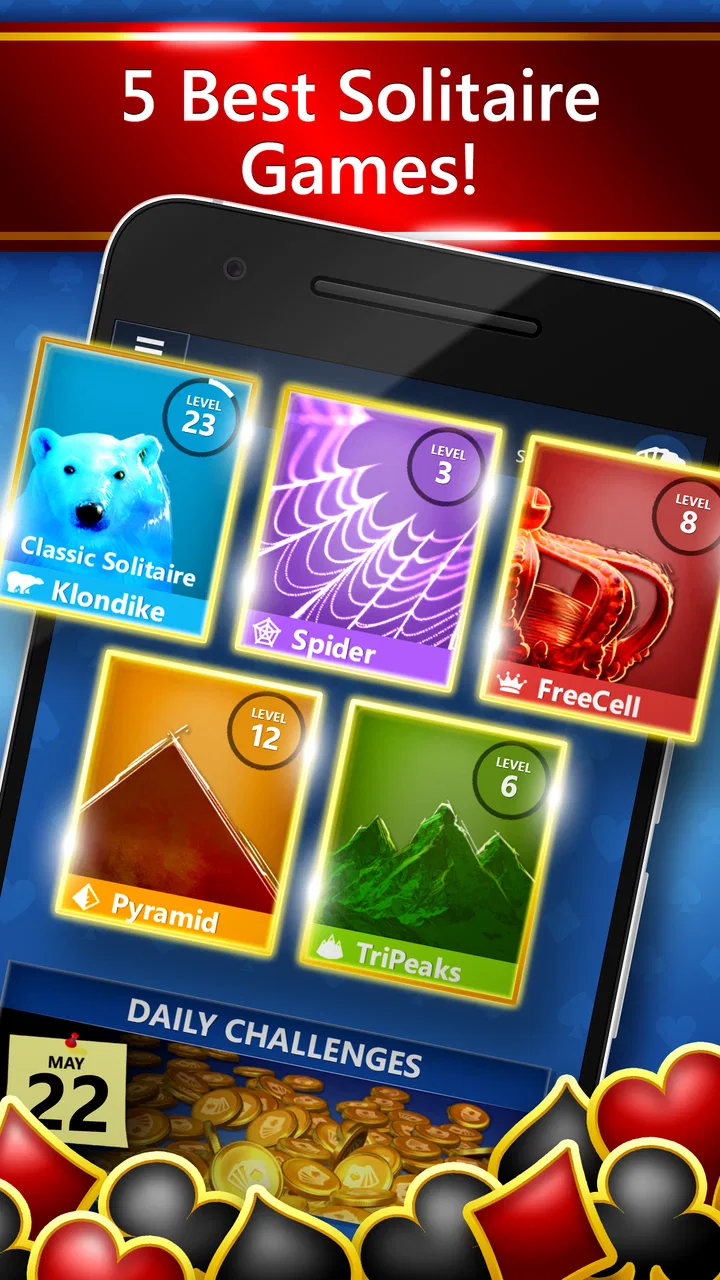
The Microsoft Solitaire Collection includes five classic solitaire card games: Klondike, Spider, FreeCell, Pyramid, and TriPeaks. Each game offers a unique set of rules and challenges, catering to both beginners and seasoned players. With daily challenges and various difficulty levels, it provides endless hours of entertainment.
02Is the Microsoft Solitaire Collection free to play?
Yes, the Microsoft Solitaire Collection is free to download and play. However, it offers in-app purchases for premium features, such as ad-free gameplay and additional game themes. Players can also subscribe to Microsoft Solitaire Collection Premium to enhance their gaming experience with exclusive benefits.
03Does the Microsoft Solitaire Collection require an internet connection?
While the core games can be played offline, an internet connection is required for certain features. For instance, daily challenges, cloud saving, and Xbox Live integration—which allows players to track achievements and compete with friends—require an online connection to function properly.
04Can I sync my progress across multiple devices?
Yes, by signing in with a Microsoft account, you can sync your progress across multiple devices. This feature allows you to pick up where you left off, regardless of the device you are using. It is particularly useful for players who enjoy gaming on both mobile and desktop platforms.
05Are there any accessibility features in the Microsoft Solitaire Collection?
The Microsoft Solitaire Collection is designed with accessibility in mind, offering features like adjustable card size and colorblind mode. These options ensure that the game is accessible to a wider audience, accommodating players with different needs and preferences, and enhancing the overall gaming experience.
Pros
- Wide variety of solitaire games included.
- Daily challenges keep gameplay fresh.
- User-friendly interface with smooth navigation.
- Cross-platform sync for progress tracking.
- Offers both relaxing and competitive modes.
Cons
- Frequent ads can disrupt gameplay.
- Requires internet for some features.
- Limited customization options.
- In-app purchases for premium features.
- Occasional lag on older devices.

Microsoft Solitaire Collection
Gallery